I don’t know the tree. Is this tree a major feature of the local landscape? As in by comparison to other local trees…. Sure some small birds live
a long time, but a six year gap sort of suggests it is likely to be an independent occurrence, rather than the same birds returning (implied by (site fidelity”).
Something about Geoffrey’s comment about “the theory that the Painted Honeyeater was an important spreader of mistletoe in Gondwana before the
arrival of the Mistletoebird.”
Is that a comment about place or time? Is there a good basis for that the Mistletoebird arrived here and the Painted Honeyeater didn’t, or that it happened in that time sequence. Maybe based on that the Mistletoebird has related species in south-east Asia,
whilst honeyeaters are an Australian group. The word autochthonous is relevant (as distinct from just native). It means native or indigenous to the place where it originates. So is the honeyeater autochthonous here but the Mistletoebird isn’t? I don’t know.
I intended to post this on Sunday, but I forgot to check on the spelling of autochthonous………..
Philip
From: Canberrabirds
On Behalf Of Julie Hotchin via Canberrabirds
Sent: Sunday, 18 October, 2026 12:39 PM
To: Geoffrey Dabb <>
Cc: Canberrabirds <>
Subject: Re: [Canberrabirds] Painted Honeyeater
Thanks for these images of the nesting Painted Honeyeaters, Geoffrey, and for the insights into the unique way they spread mistletoe berries. It's good to learn a little more about these rare visitors to our region.
I have a question about the geographical movements of this species that you - or others on this list - may be able to shed some light on. I'm intrigued by the fact that this year they returned to the same gracious, large old yellow box
in Campbell Park where they were recorded in October and November 2020. Do we know anything about their site-fidelity? Or, is the popularity of this old tree more likely to be a coincidence as the birds are attracted to a site with suitable large eucalypts
that support fruiting mistletoe?
In his columns in Gang-gang in November and December 2020, Jack commented that it appeared surprising that the birds appeared in Canberra at that time, as it had been a wet spring, like this year. Do we know how weather patterns
and/or rainfall might affect their movements, or is the search for mistletoe the determining factor? Which then begs the question about how rainfall affects mistletoe fruiting . . .
I welcome any thoughts about this.
Cheers,
Julie
On Sat, 17 Oct 2026 at 10:56, Geoffrey Dabb via Canberrabirds <> wrote:
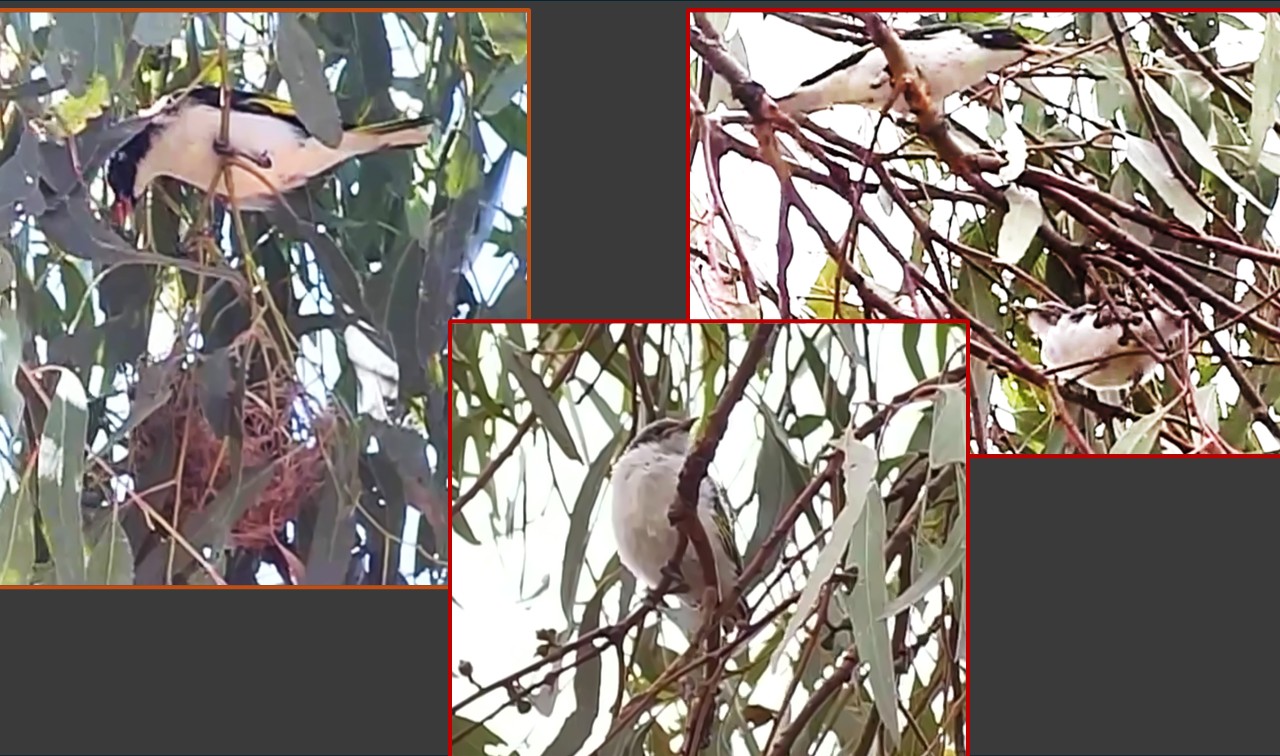
I found some primitive video of the successful nesting here in 2002. This was obtained for a little video project about the theory that the Painted Honeyeater was an important
spreader of mistletoe in Gondwana before the arrival of the Mistletoebird. The point was that the adults need a special ability to make use of mistletoe berries as food for the young, because of the long sticky threads of excreted berries. The shortlegged
Mistletoebird has a different technique related to different nest construction, perhaps different digestive process. In 2002 young were fed insects in first few days including small cicadas. After leaving nest young remained here for only one day before
the family moved off.
--
This is the email announcement and discussion list of the Canberra Ornithologists Group.
Emails posted to the list that exceed 2 MB (2,000 kB) in size, including attachments, will be rejected.
All emails distributed via the list are archived at
http://bioacoustics.cse.unsw.edu.au/archives/html/canberrabirds. It is a condition of list membership that you agree to your contributions being archived.
Canberrabirds mailing list
https://lists.canberrabirds.org.au/mailman/listinfo/canberrabirds