[To find out what HANZAB is, see
Handbook of Australian, New Zealand and Antarctic Birds.]
The information in the online version of HANZAB is in a state of flux with significant changes in each release. An important part of reading HANZAB entries is to understand what changes have been made or not made.
To assist the reader’s understand the status of the text, three pieces of information are provided:
- the
Release Notes - mainly documents changes applied across the website
- the
Taxonomic changes section, in each order, family, subfamily and species entry, documents taxonomic and nomenclature changes
- the
Content updates section on each page where the text has been altered.
The text should be read in the context of this information.
Within an entry, there will be links above the title if there are taxonomic changes or
content changes, and a notification (not a link) if the entry has been revised (an entry has undergone a complete review and update). The contents of the links, if they are present, should be checked to understand the
state of the information.
Below are examples, with the information and screenshots taken from Release 2.01.
The Release Notes page mostly documents changes applied to the whole site such as accessibility changes, changes to search functionality, the activation of comments, and an overview of taxonomic changes such as the move to AviList
2025. For example, the Release Notes page documents that the change to AviList 2025 was applied in Release 2.0 on 19 January 2026:
Release 2.0 (19 January 2026)
·
Changed to align with
AviList 2025
o
Changed
taxonomic sequence and scientific names of orders, families and species to align with AviList 2025. Subfamilies are not included in AviList yet but have been retained in HANZAB.
o
…
Release 2.0 also included activation of comments and changes to search, other English names, IUCN status, accessibility, and multimedia links, all documented on the Release Notes page.
The Taxonomic changes section in each order, family and species describes any changes for these entries resulting from the initial creation of HANZAB online or the change to AviList 2025. If, for example, a species has been split
, the entry will have a link above the title to indicate there has been a taxonomic change, and which change is the latest to cause the entry to be modified (the only taxonomic changes at this stage are the initial one, HANZAB 2023 which updated the HANZAB
book taxonomy, and AviList 2025). Grey Fantail is an example of a species which was split in the initial release.
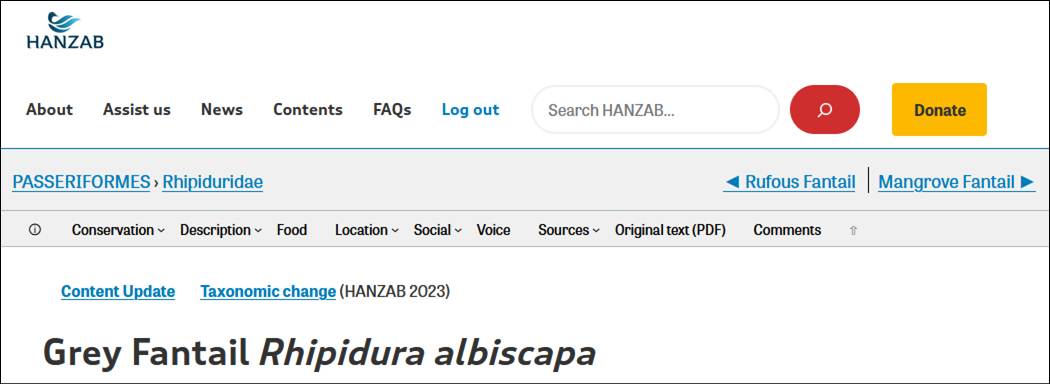
In the case of Grey Fantail, the New Zealand and Lord Howe subspecies were split into a separate species, New Zealand Fantail. At this stage, the text of the Grey Fantail entry has not been changed to reflect this change but an entry for
New Zealand Fantail has been established with only masthead information (masthead information is the information at the top of the entry, separated from the text by a line of five dots). To assist the reader, the Taxonomic changes section describes the change.
In Grey Fantail, the Taxonomic changes as at Release 2.01 are:
- HANZAB 2023
- Family change – Dicruridae in HANZAB
book.
- Grey Fantail Rhipidura fuliginosa in HANZAB book (see Original Text below)
split:
- Grey Fantail Rhipidura albiscapa (subspecies albicauda, albiscapa, alisteri,
keasti, pelzelni, preissi, bulgeri and brenchleyi)
- New Zealand Fantail Rhipidura fuliginosa (subspecies fuliginosa, placabilis, penita and cervina).
Text does not reflect this change.
Re the family change mentioned for Grey Fantail, the current family for a species is shown as links above the title (see screen image above). For Grey Fantail this is:
PASSERIFORMES ›
Rhipiduridae
In New Zealand Fantail, the Taxonomic changes are:
- HANZAB 2023
- Grey Fantail Rhipidura fuliginosa in HANZAB book (see Original
Text below) split:
- Grey Fantail Rhipidura albiscapa (subspecies albicauda, albiscapa, alisteri,
keasti, pelzelni and preissi)
- New Zealand Fantail Rhipidura fuliginosa (subspecies fuliginosa, placabilis, penita and cervina).
Text to be added.
By reading the Taxonomic changes , the reader should, in most cases, be able to determine what information in the unchanged Grey Fantail entry applies to the Grey Fantail (after the split) and what applies to New Zealand Fantail.
[Note, the New Zealand Fantail text extracted from the Grey Fantail entry is to be included in the next release – release 2.1.]
Where a species has been split and the text has not been added, as in New Zealand Fantail in Release 2.01, the links should guide the reader to the text as it was before the split (Grey Fantail). In this case, the HANZAB book entry for
Grey Fantail helpfully recognised two main groups, which align with the split, and organised much of the information by them:
(1) albiscapa group, comprising subspecies (all pied morph) in Aust. and on Norfolk I.; and
(2) fuliginosa group, comprising subspecies (pied and black morphs) in NZ and on Chatham Is. [Lord Howe subspecies
cervina is also part of this group but is extinct].
Content updates. In the Grey Fantail entry the text above the title, as shown above, also indicates that there has been an update to the content. In this case, the update does not have a date as it only applies to the addition of
the Conservation Status section. However, in other entries the Content Update above the title may be followed by a date and release number. For example, in Rufous Fantail.
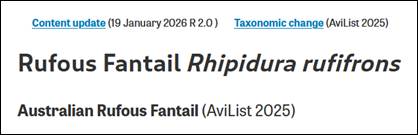
Here the Content Update is followed by “(19 January 2026 R 2.0 )”, to indicate the latest change to the content was made in Release 2.0 (R 2.0), which was done on 19 January 2026. The text in the Content Updates section is:
Release 2.0
·
IUCN status changed from Least Concern to Not Evaluated due to taxonomic change in AviList 2025
The taxonomic change referred to in the Content Updates section is documented in the Taxonomic Changes section:
- AviList 2025
- Rufous Fantail complex (Rhipidura rufifrons and Rhipidura dryas) divided into eight species, with three recorded in HANZAB
region:
- Arafura Fantail Rhipidura dryas with two subspecies, dryas and streptophora (HANZAB
2023 subspecies semicollaris now Supertramp Fantail)
- Australian Rufous Fantail Rhipidura rufifrons with two subspecies, intermedia and rufifrons (no extralimital subspecies)
- Supertramp Fantail Rhipidura semicollaris with nine
subspecies
Note that Rufous Fantail is called Australian Rufous Fantail in AviList 2025. The difference in English and/or scientific name is shown below the title (see screen image above).
Where the entry has been revised, see the Content updates for a description of the sections changed. For example, Albert’s Lyrebird has been revised.

In the Content updates:
Release 1.2
·
description of the last revision (see below) updated with the sections that have changed
·
accessibility changes to headings and tables
Release 1.1
·
Text revised by F. Cehak & F. Backhouse. Sections changed (other than minor text changes):
o
Field Identification (introduction; Similar species)
o
Distribution and Population (Change in range, populations)
o
Threats and Human Interactions
o
Movements (Banding)
o
Social Organisation (introduction; Bonds; Size of territories)
o
Social Behaviour (Display with tail; Copulation)
o
Voice
o
Breeding (Season; Site; Nest Materials,Measurements)
o
Moults (Adult post-breeding )
o
Weights
o
References
o
abbreviations have been removed eg ne change to north east
To determine the date of the releases, see the Releases Notes page. In the case above, the release dates in the Release Notes page are:
- Release 1.2 (10 June 2025)
- Release 1.1 (11 March 2025)
Note that the information above was extracted from Release 2.0.1 and will most likely change with future HANZAB releases.
I hope this helps readers of HANZAB. If any points are not clear and I have managed to confuse people, I am happy to try to clarify.
Cheers
Steve
P.S. Each HANZAB entry has an area to comment on errors in the HANZAB text or suggest updates to the information (including source). Your help improving HANZAB would be welcomed.