A magpie discussion presents an opportunity for raising the matter of scientific usefulness of eBird, particularly photos. A scientific paper might discuss in detail the significance of location of an unusual specimen
on a museum tray, while ignoring a perfectly clear photo of a similar specimen in an eBird report. Perhaps that will change. I should mention I am not an eBirder but I am a keen student of the results of the activity.
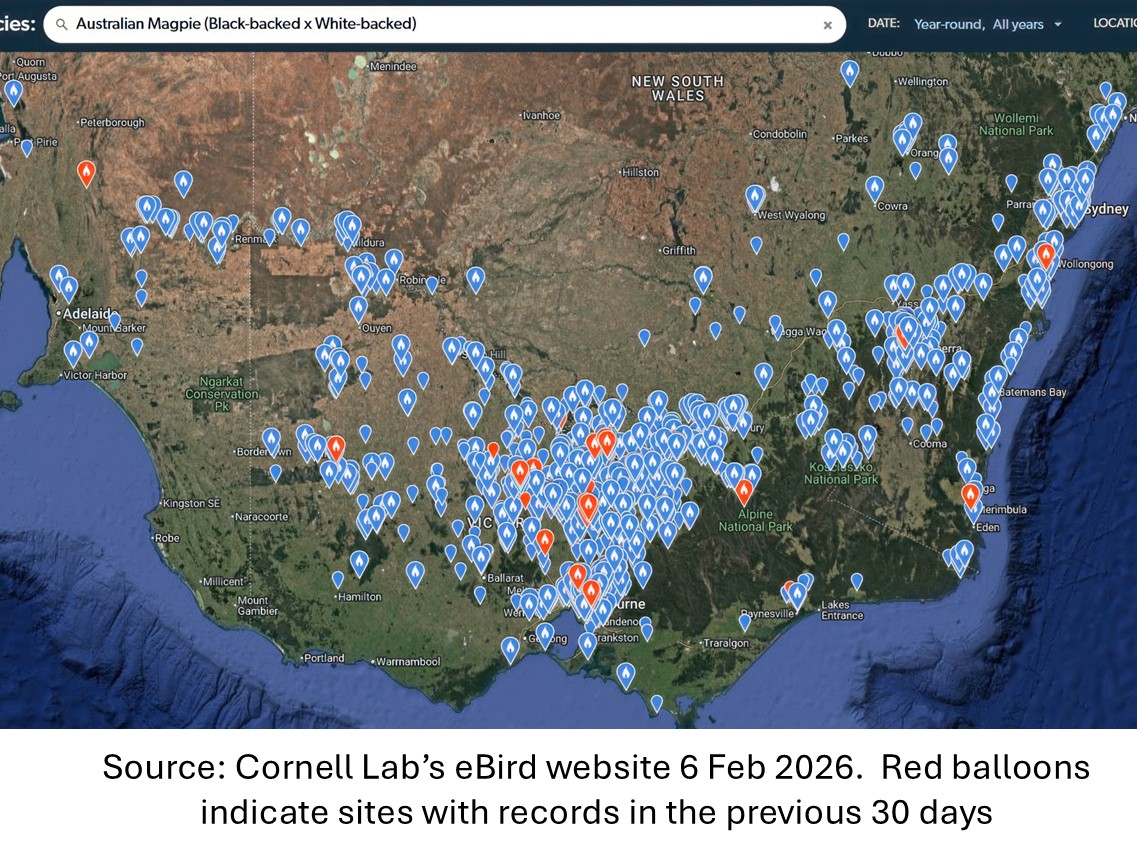
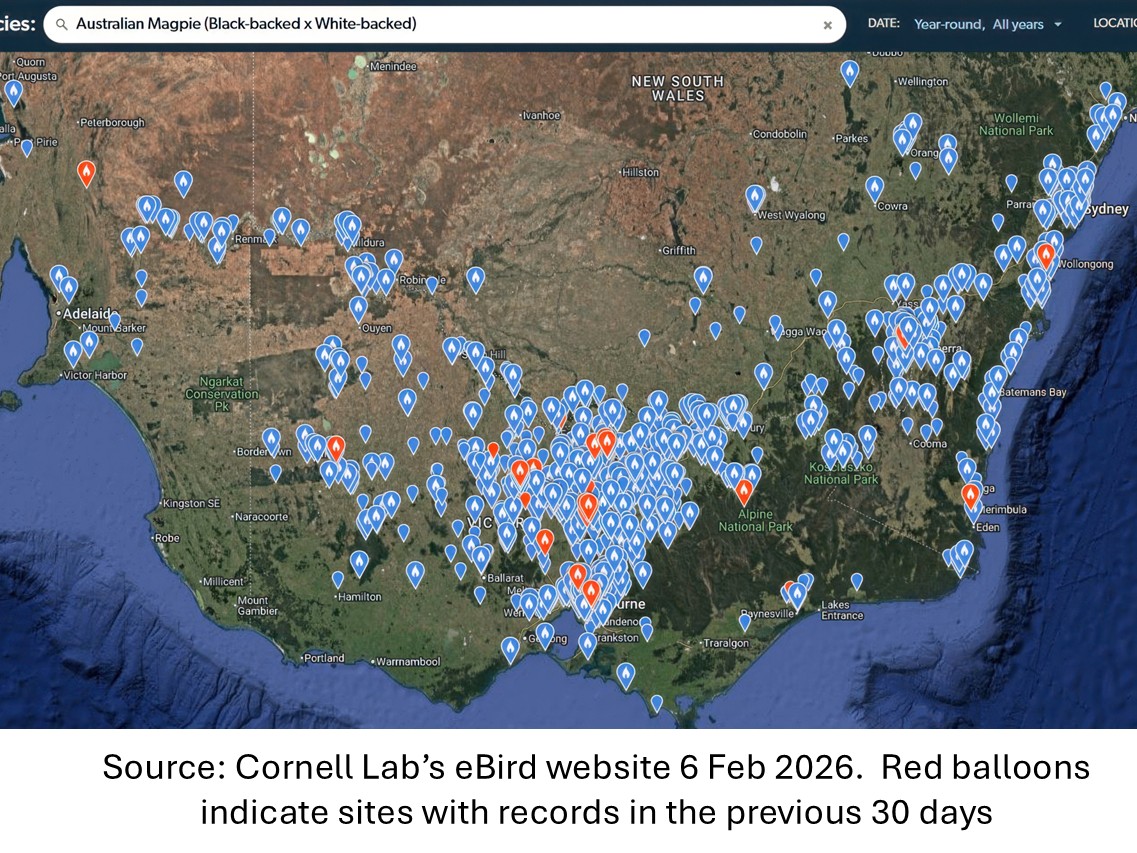
eBird enables recording of magpie subspecies, although only a small proportion of recorders use that option. It also enables recording of ‘Australian Magpie (Black-backed x White-backed)
Gymnorhina tibicen [tibicen Group] x telenocua/tyrannica’. An overview of such records is attached, each balloon representing a site with at least one record, sometimes several records. All records can be viewed in detail. The records, including
photos, will be of a plumage type. It would be a step further to say that each relates to a hybrid between the named subspecies in the accepted scientific sense, but that is the issue being raised here.
It will be seen that the recorded ‘hybrids’ extend well beyond the suggested intergrade zone. A photo from near Coff’s Harbour is offered, reasonably, as an example of the hybrid category. It is accompanied by records
of six ‘Australian Magpie (Black-backed)’. An excellent series of photos from Tasmania in May 2025 could have been taken in Canberra. They are put forward as a ‘Mainland Magpie’, along with three records of ‘Australian Magpie (Tasmanian)’. Surely these
examples cannot be dismissed with ‘Oh yes, those variations crop up from time to time’. The question is whether the apparent out-of area individuals flew there from their home territories or are the result of something in the genes of the local birds. In
the case of the Melbourne area records, is this evidence of southward movement of the intergrade zone?