Good. I expect that the Hughes J, is Jane Hughes who was a post graduate student at La Trobe University working in the genetics or zoology department
on magpie variation, when I was doing my honours year there (1978). As I recall her telling in a seminar at some time thereafter, genetic markers for diversity don’t really align in any meaningful way (geographically) with back colour variation. The back colour
is one of a range of genetic variations but happens to be the one that is obvious to us. That is the way I remember it. Of course, I could remember the name wrongly or it could be someone else.
Philip
From: Canberrabirds
On Behalf Of Geoffrey Dabb via Canberrabirds
Sent: Thursday, 5 February, 2026 3:10 PM
To: Canberrabirds <>
Subject: [Canberrabirds] In search of Our Magpie, 4
All those people crying out for access to HANZAB now have it online, thanks to our Steve Wallace, and a few others. As an early priority they will have gone to vol 7A, p. 619 to read about geographical variation in the Australian Magpie,
to be met by the daunting words ‘very complex, and views concerning species and subspecies vary considerably’. Seriously, just p. 621 about hybrids between White-backed and Black-backed birds is worth a look. In our region, with an ACT set of birds being
mentioned specifically, there are populations with a mix of plumage types.
HANZAB takes us to 2006, and to my inexpert eye not very much has been done since then to advance our understanding of the subject. However, I see that Jamie Matthew, compiler of the magpie entry in HANZAB, became co-author of a significant
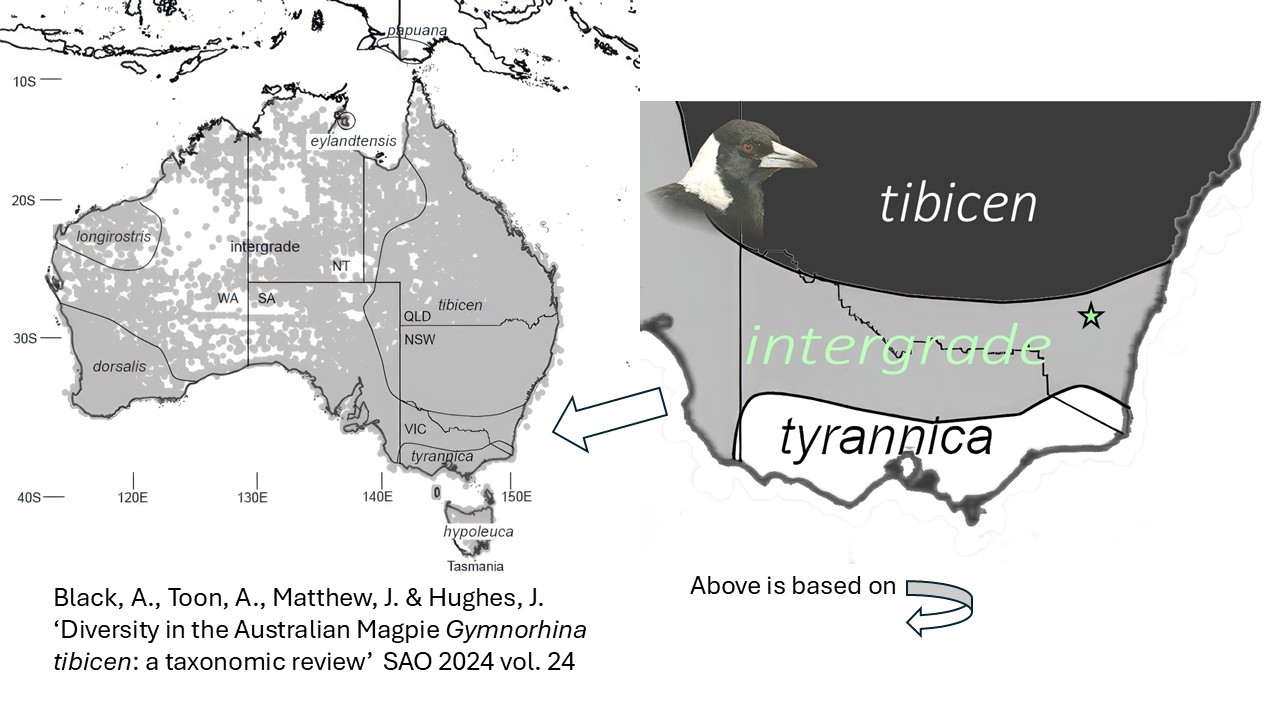
paper by Andrew Black et al. in 2024. This proposed arrangement, helpfully in our area, reduces the number of mainland subspecies to four. It also gives a vast intergrade area, boundaries approximate, but including Canberra, where the magpie population is
not to be assigned to any single subspecies. Next: eBird and the Magpies